







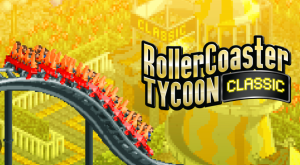






RollerCoaster Tycoon is a theme park management simulation game developed by Chris Sawyer and published by Hasbro Interactive, released in 1999. It is widely regarded as one of the greatest PC games ever made and is credited with defining and popularizing the theme park simulation genre. What makes its origin story particularly remarkable is that Chris Sawyer wrote almost the entire game himself in assembly language — an extremely low-level programming language that most developers avoid due to its complexity — a feat that was almost unheard of for a commercial game of its scope at the time. The result was a game that ran with exceptional efficiency and packed an enormous amount of detail into a relatively small file size.
The premise of RollerCoaster Tycoon is straightforward but deeply engaging. Players are given a plot of land and a budget, and their goal is to build and manage a successful theme park. This involves constructing roller coasters and other rides, hiring staff, setting ticket prices, managing finances, landscaping the park, and keeping guests happy. Each scenario comes with its own unique objectives, usually centered around reaching a target number of park guests within a set number of in-game years, though some scenarios challenge players to achieve a certain park value or pay off a loan. There are dozens of scenarios included in the base game, ranging from relatively easy beginner parks to brutally difficult plots of land that test even experienced players.The ride construction system is where the game truly shines. Players can build custom roller coasters piece by piece, laying track through the air and adjusting height, curves, and special elements like loops and corkscrews. Every coaster is then tested and given ratings for excitement, intensity, and nausea, which affect how many guests are willing to ride it. Building a coaster that scores high on excitement while keeping nausea low is a genuine puzzle that rewards creativity and experimentation. Beyond coasters, the game offers a wide variety of flat rides, gentle rides, water rides, and transport rides, giving players plenty of tools to fill out their park and cater to different types of guests.
How to Unblock Hyperchats Now and Play Theme Park Tycoon!
The guest simulation system adds another layer of depth. Each visitor in the park is an individual with their own happiness level, hunger, thirst, energy, and opinions about the park. They complain when paths are too crowded, when rides break down, when there aren’t enough trash cans, or when food stalls are too expensive. Managing these needs requires players to think carefully about park layout, staff placement, and pricing strategy. Mechanics like these gave the game a surprising amount of strategic substance beneath its colorful and charming surface. Visually, RollerCoaster Tycoon used an isometric perspective with detailed sprite-based graphics that held up remarkably well for the era. The sound design was equally strong, with cheerful fairground music, ambient crowd noise, and satisfying mechanical sounds that made the park feel alive. The overall atmosphere was warm, inviting, and just detailed enough to spark the imagination.RollerCoaster Tycoon was a massive commercial and critical success upon release, winning numerous awards and selling millions of copies worldwide. It spawned two direct sequels — RollerCoaster Tycoon 2 in 2002 and RollerCoaster Tycoon 3 in 2004 — along with various spinoffs and mobile entries over the following decades. Its legacy has proven remarkably durable, and an active fan community continues to create new scenarios, tools, and mods for the game to this day, keeping it alive and playable well into the modern era.
Review Theme Park Tycoon